

Compute the resistance before you commit to the molecule.
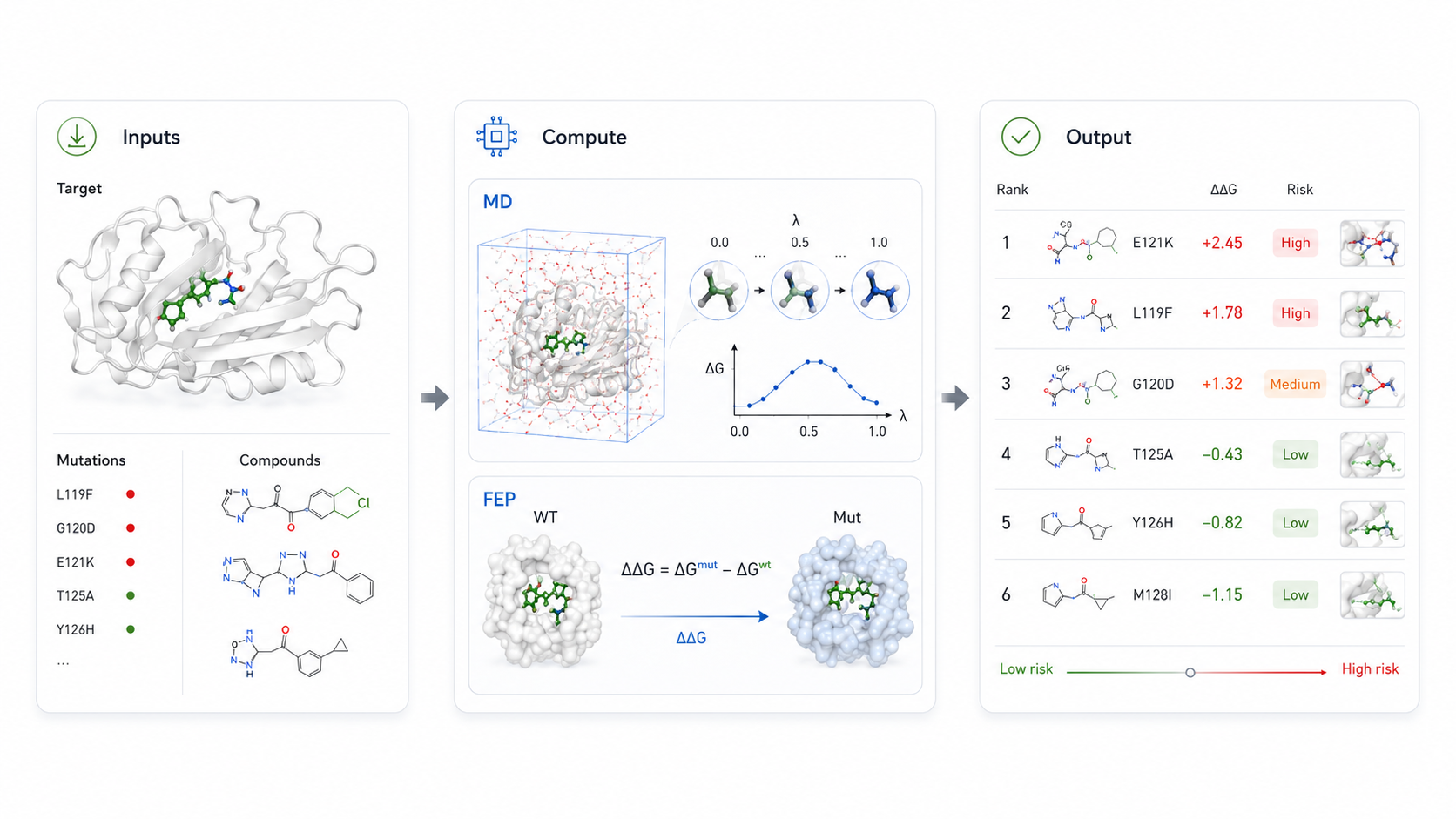
MutFEP evaluates how a point mutation in your target changes the binding free energy of your compound. Not a docking score, not a prediction from a trained model, the free energy difference itself, calculated from molecular dynamics.
You give us a target structure, a mutation list, and one or more compounds. You get back a ΔΔG for every compound; mutation pair, ranked, with the mechanism behind each loss of affinity.
Physics, not pattern-matching.
The method is alchemical free energy perturbation. There is no training set, so there is no question of whether your target resembles the data the model learned from. The calculation runs on the structure in front of it.
Panels, not single points.
Mutations are run concurrently on HPC rather than sequentially. Panel size is a compute question, not a schedule question.
Weeks, not seasons.
A mutation panel returns in weeks. The assay-and-field-trial route that currently answers this question returns in years, and only after the compound exists.
A report, not software.
You are not buying a licence, a platform seat, or a pipeline to maintain. You receive a resistance risk report your chemists can act on.

Where it works, and where it doesn't.
Target-site point mutations are what this method is built for, and where the published error is small enough to make decisions on.
Metabolic resistance, target overexpression, and efflux are outside scope. We compute binding.